

When companies operate in regulated environments, translation is not a linguistic concern. It is a matter of control, traceability, and risk. Yet many organizations still view ISO 17100 as a technical badge owned by the provider, rather than what it actually is: a framework designed to protect the client.
Talking about ISO 17100 translation means understanding how a structured process prevents critical errors before they occur. It is not about fixing issues later, but about designing a system that reduces the likelihood of failure from the start. This is especially relevant for quality, compliance, and procurement teams, where every translated document may become evidence during audits, regulatory reviews, or strategic negotiations.
ISO 17100 defines clear requirements for professional competence, workflows, independent revision, and project management. Its true value, however, lies in the operational impact it creates when properly implemented. A certified process forces accountability, documents decisions, and removes improvisation. Translation becomes a governed process.
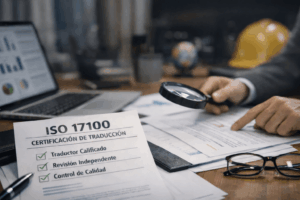 In practice, each text goes through verifiable stages: translation by qualified professionals, independent review by a second linguist, terminology consistency checks, and final validations aligned with the document’s purpose. For the client, this results in consistency, predictability, and reduced risk exposure.
In regulated companies, translation errors rarely appear immediately. They surface later during audits, when inconsistencies are detected, or when legal documents lead to ambiguous interpretations. ISO 17100 translation works as a preventive filter against these scenarios. It does not eliminate risk, but it manages it systematically.
Most importantly, the standard protects the client’s process, not the provider. It requires full traceability: who translated, who reviewed, under which criteria and which source version. This information becomes critical when decisions must be justified or documentation histories reconstructed.
When combined with management systems such as ISO 9001, ISO 17100 strengthens governance and continuous improvement. Together, they create an environment where quality depends on systems, not individuals.
This is the operational reality of companies like yours. Organizations operating across markets that need to ensure multilingual communication does not become a vulnerability. In these contexts, working with an ISO 17100–aligned provider is not a technical choice. It is a strategic one.
Learn about our Privacy and Confidentiality Policy