

In many global organizations, language services evolve organically. One provider handles technical translations, another supports legal documentation, another covers interpretation, and yet another is called when urgent requests appear.
At first glance, this structure may seem flexible. Yet over time, procurement teams and executives begin to notice something important: the system becomes increasingly complex, and hidden operational risks start to accumulate.
When a company decides to consolidate translation providers, the impact goes far beyond administrative simplification. It becomes a strategic decision that directly influences document governance, operational continuity, and risk control.
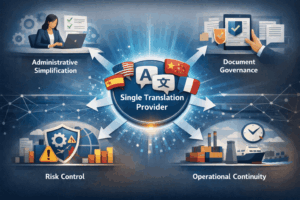
Fragmented language supply chains create something that rarely appears in performance dashboards: invisible errors.
Each vendor works with its own translation memories, terminology decisions, and quality control processes. Even when each individual delivery looks correct, the overall linguistic ecosystem of the organization slowly loses consistency.
This happens in the real operational environments of companies like yours.
A contract may use terminology that differs from a technical report. A manual may refer to a process using a term that does not match regulatory documentation. In regulated industries, these inconsistencies are not merely linguistic issues. They can quickly become compliance risks.
That is why many organizations are now reviewing their language supply structures and choosing to consolidate translation providers under a strategic model.
Consolidation makes something possible that is difficult to achieve with dispersed vendors: real document governance.
When a strategic provider manages the full linguistic ecosystem, translation memories, terminology databases, and review processes can be centralized. Terminology decisions stop being isolated choices and instead become part of an institutional framework.
This type of linguistic governance becomes particularly valuable when organizations operate in environments where document control is critical.
For example, regulated sectors where audits require strict consistency between documents, versions, and updates. In such contexts, linguistic traceability becomes an extension of the company’s quality system.
International standards such as ISO 17100 define specific processes for professional translation services, including independent revision and documented quality control. Likewise, frameworks like ISO 9001 emphasize consistent and verifiable processes.
When a company decides to consolidate translation providers, it not only simplifies operations. It also creates the conditions necessary for these standards to be implemented consistently across the entire linguistic workflow.
Another often overlooked advantage is operational efficiency.
Every new vendor requires onboarding, terminology alignment, knowledge transfer, and administrative coordination. When projects are distributed across multiple suppliers, internal teams often spend significant time coordinating, explaining, and correcting.
In a consolidated model, the strategic provider accumulates knowledge about the organization, its products, its documentation culture, and its technical terminology. Over time, that knowledge reduces rework, accelerates delivery, and improves accuracy.
 In practical terms, consolidation transforms the provider relationship.
Instead of acting as a tactical resource executing isolated tasks, the provider becomes a partner who understands the operational context of the business.
From a corporate governance perspective, this evolution has meaningful implications. Fewer vendors mean fewer failure points, fewer inconsistencies, and greater traceability across critical communication processes.
In a global business environment where companies operate across multiple languages, markets, and regulatory frameworks, that traceability is not optional.
It is essential for operating with confidence.
That is why many procurement teams are no longer asking whether multiple language vendors are convenient.
The real question is how much invisible risk fragmentation may be creating.
Because when language becomes part of business operations, consolidating providers is not just an administrative choice.
It is a governance decision.
Learn more about our Privacy and Confidentiality Policy.